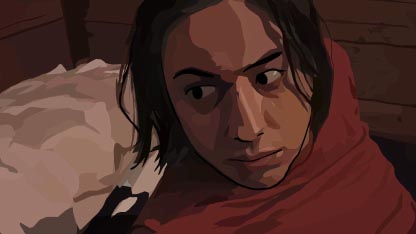
The second chapter of Waking Life introduces the boat-car driver and the stranger.
Determinism
The second passenger determines, at random, where the main character will exit the boat-car. This act brings into question free will, and whether each individual is capable of making their own decisions. Socrates subtly touches on this topic when he fabricates the 'myth of metals'. The myth describes a specific hierarchy in which the golds are leaders, "but the god, in fashioning the of you who are competent to rule, mixed god in at their birth" (415a), and are described by the term "guardians". These individuals do not execute their power in a manner that is expected by members of the 21st century, aside from laying down laws and maintaining peace, "Let them look out for the fairest place in the city for a military camp, from which they could most control those within, if anyone were not willing to obey the laws, and ward off those from without, if an enemy like a wolf should attack the flock" (415d), they "control those within". This control is meant to preserve the happiness of the city, "They alone are masters of the occasion to govern it well and make it happy" (421a), yet to a great extent it limits the freedoms of the citizens through censorship, "It's appropriate for founders to know the models according to which the poets must tell their tales" (379a). The power of determinism that is placed upon the guardians extends to many parts of life in the city, from education to censorship, extending as far as deciding which people are allowed to live, "Will you set down a law in the city providing as well for an art of medicine such as we described along with an art of judging, which will care for those of your citizens who have good natures in body and soul; while those who haven't, they'll let die the ones whose bodies are such, and those whose souls are incurable, they themselves will kill?" (410a). And since it is decided who may live and who will die it is essential that who will be born will also be dictated, "There is a need for the best men to have intercourse as often as possible with the best women, and the revers for the most ordinary men with the most ordinary women" (459e).
To Socrates this determinism is essential in the "City in Speech" in order that the city function as well as possible. But observing the idea of the city from an external perspective it can be said that the inherent lack of freedom is unreasonable, that no person would give up their right to free will. This view is explicitly stated in Waking Life by several of the characters, yet it is also noted by Socrates when he describes how the city would come into being, "All those in the city who happen to be older than ten they will send out to the country; and taking over their children, they will rear them - far away from those dispositions they now have from their parents - in their own manners and laws that are such as we described before" (541a). This insight presented by both texts speaks to the notion that the city is impossible, not only due to circumstances but that no one would comply, let alone allow their freedoms to be taken in such a manner.
To Socrates this determinism is essential in the "City in Speech" in order that the city function as well as possible. But observing the idea of the city from an external perspective it can be said that the inherent lack of freedom is unreasonable, that no person would give up their right to free will. This view is explicitly stated in Waking Life by several of the characters, yet it is also noted by Socrates when he describes how the city would come into being, "All those in the city who happen to be older than ten they will send out to the country; and taking over their children, they will rear them - far away from those dispositions they now have from their parents - in their own manners and laws that are such as we described before" (541a). This insight presented by both texts speaks to the notion that the city is impossible, not only due to circumstances but that no one would comply, let alone allow their freedoms to be taken in such a manner.